Showing posts with label abe books. Show all posts

Thursday, February 2, 2012

How Many Times can a Book Break Your Heart?

When I first saw the preview's for the movie "Extremely Loud and Incredibly Close", my first instinct was to avoid this movie.  Although I enjoy Sandra Bullock and Tom Hanks, who co-star in it, the theme was 9/11, a topic, like the Holocaust, which is very hard for me to digest without a horrible stomachache and a lot of tears.

My husband, E, upon seeing the preview, said, "You might want to see this movie."  "No way," I said.  Can't handle the 9/11 theme, but my subconscious started chewing on what I had seen and I realized that I had already read the book, years ago, and had really been touched by it.

I ordered a copy for my school library, barcoded it, then set down to "review" it for my students.  (I love how my homework is to read books.  My job rules.)

Very quickly, the plot came back to me.  Nine-year-old Oskar Schell's father died in 9/11.  Oskar and his father had a pretty amazing relationship.  Being an only child, his father spent in inordinate amount of time with him, creating quests that took the boy all over NYC.  His father's death, however, and a mysterious key found in a cryptic envelope in his father's closet, sends Oskar on the wildest and most emotional journey yet.

Determined to discover what the key is for, Oskar meets people of every possible type.  Oskar himself is quite an unusual child, constantly creating in his mind new inventions, like parachutes for skyscrapers and water from your shower that was chemically treated to turn your skin the color of your mood, which would be helpful to signal to others when to be gentle with you, as well as to help you figure out how, exactly, you are feeling.

Interspersed with the story are photos representing what the character is experiencing at the time, as well as a story written by Oskar's grandfather for his unborn son, whom he abandoned before his birth.
"You look upset. Is anything wrong?"  I wanted to say, "Of course,"  I wanted to ask, "Is anything right?"
 
This book is a bit on on the adult side, so I may limit its check-outs to 8th graders only, and let them know there is some content they might not yet be ready for (sex) but I have found that the students here who can actually finish a book, are probably ready to read what I have in here.


As far as seeing the movie?  Yeah, I'll do it.  I might sit in the back row, by myself, with a box of tissues, but I feel I owe it to Oskar to relive his journey one more time.

Thanks for listening.

Friday, January 20, 2012

Who Would I be Without Books?

Sometimes I wonder who I would be if I wasn't a reader.  Decidedly less dimensional, and probably more bored with life, I've decided.

Where would my mind wander if I wasn't immersed in the safe world of others' drama (without the messy drawback of being emotionally tied to them in real life)?  When the game is on TV or conversation lags, my brain flits back to the unfinished story in my car or by my bed, working the plot pieces like a puzzle, happy both when I figure out that I was indeed right about what happens next or if it turns out I was clueless.

Right now I am fully involved in two plot lines.  (Three, if you count Discordia, which I am reading with my son.)  As usual these days, when reading something really good, I think, "I should blog about this book."  Problem is, I am often on to another book right away and my interest in sharing with you what I just experienced fades into memory.  So why wait until the stories are over before telling you about them?  I am excited about the plots right now.  Maybe I'll write more to you when I've finished the books, but probably not.  Maybe they will seem even more enticing to you with little clue as to the finale.

Right now in my truck, I am on disk 10 of the 20 disk audio version of The Lonely Polygamist by Brady Udall.  Who isn't fascinated by the world of polygamy?   As a person who loves books with intricate characters and their interactions with what life has in store for them, this book rocks.  Goldie (short for Golden) has 4 wives (and is being pressured to take on a 5th), 28 children (not counting the 4 stillborn or the daughter who died young and tragically), and is attracted to his boss's wife.  (This may make him sound like a scandalous scoundrel, but he is isn't.)  Raised by a chronically depressed mother who was abandoned by her fortune hunting husband, Goldie grew up overly tall for his age and decidedly less social than those around him.  (The school authorities let his mother keep him out of school because she was very difficult to deal with.)  When Goldie is about 17, he discovers letters from his dad, including money and a plane ticket to Vegas.  Innocent and awkward, he leaves mom without notice and goes to live with dad, who is now very rich and has survived booze and too many women and has become Mormon. 

The plot zig-zags back and forth in time, filling in the blanks of the Goldie's life.  Other chapters are from the point of view of 11-year-old Rusty, one of Goldie's son's, who is so desperate for attention and physical contact that he acts out in a myriad of ways.  Goldie's fourth wife, Trish, also has a voice in the story.  Lonely and feeling like she has not done her wifely duty, Trish is aching from 3 miscarriages and resentful of the amount of time she has to sacrifice her "Goldie" time with the other wives and their children.

Goldie is awkward, sincere, and a bit socially inept, despite, his huge family.  His attraction for the wife of his boss seems to stem from his need for a calmer and simpler life.  Alternately amusing and heart-wrenching, The Lonely Polygamist is making my commute a pleasure.

During my lunches and free time at home, I am thoroughly enjoying The Scorpio Races by Maggie Stiefvater.  Written for young adults, this hauntingly beautiful story is again, written alternately in chapters by the point of view of different characters.  Kate Connolly (Puck) is reminiscent of an older Scout (To Kill A Mockingbird with her unflinching look at life, sense of humor, adult observations, and gritty spunk.  Puck and her two brothers are recently orphaned and barely managing to keep food in their bellies.  They live on an island that is known for The Scorpio Races, which are like horse races held on the beach, but the horses are capaill uisce (pronounced copple ooshka), which are wild, blood-thirsty beasts who live in the sea and are often captured when they come up to the beach to feed on whatever flesh they can  find.  Sean Patrick, also orphaned, is a strong boy, older than his years, whose gift is to understand the capaill uisce like no-one else can.  When Puck's big brother tells his siblings that he plans to move to the mainland, she impulsively decides to enter into the races, knowing that it will buy her more time with her brother, plus win them some much needed money if she wins.  I am not even halfway through with this book and already it is among my favorites.  The feeling of dangerous foreboding in my stomach at the possible bloody fate of Puck or Sean is offset by humor and witty phrasing.  I know without a doubt that this book will sit on the rack labeled "Mrs. E's Favorites" when it is back in the Library.

I like TV and movies, don't get me wrong.  I get all caught up in plot lines and impatient when I have to wait a week to see the next episode of something that has caught my eye and attention for a time.  But what I think books have done for me and my personality is open my mind the infinite and varied personalities and circumstances that exist.  I know that things are seldom as they seem.  The students in my school who are "acting out" are dealing with so many factors, they themselves are probably not aware of them all, from family dynamics and friendships, to hormones and unexpressed emotions.  Not just the kids, mind you, everyone is so very, very complex, and being a reader has helped me to appreciate it all.

Thanks for listening. 

Wednesday, May 18, 2011

Surrounded by Darkness

Sometimes I am just drawn to the dark stories.

At any one time, I am reading multiple books, so it tends to even out, but right now, I am surrounded by misunderstanding, lies, death and deceit. 

Not 5 minutes ago, I finished my latest audio book, Sharp Objects by Gillian Flynn. 

I don't often listen to murder stories in my car, especially by authors unknown to me.  There is something vulnerable about being read to, all alone, as I drive the 45 minute commute to and from work.  For some reason, this story about murdered little girls and a woman who cuts words into her skin beckoned. 
Perhaps I was curious about the words she picked and placed such as "wicked" above her hipbone and "harmful" on her wrist, which made me want to delve into this darkness.    Whatever the reason, I am glad I heard the story, but will be haunted by it for a long time.

Camille is a reporter who lives in Chicago, but grew up in a tiny go-nowhere-town in Tennessee called Wind Gap.  The first of three daughters to a spoiled, rich heiress, Camille grew up around politeness so thick you could cut it with the pig slaughtering knife that had made her family its money.  Camille and her mother don't speak too much, and when they do, nothing much is said.  Her middle sister died when she was only 13 and her younger sister is about 15 years her junior.  Sometimes Camille doesn't even remember that she exists.

When two girls are murdered in this tiny town, Camille's editor orders her to go home and get the scoop.  She doesn't want to go.  Too many memories of a cold, loveless childhood and the ghost of her dead sister.  She goes anyway.

What follows is a really messed up story about sick family dynamics and jealousy.  Who has killed these little girls?  Why were their teeth removed?  How did her sister really die?  Delving deep into the subjects of alcoholism, cutting, Munchhausen Syndrome, and denial, the book kept me rapt until the very end.  I sat in my car in the driveway to finish it up.  Although my mind had run through the list of suspects throughout the whole story, the ending was still a shocker.  When I looked up the website for the book, http://gillian-flynn.com/sharp-objects/, I saw that the first review had been written by Stephen King.  Figures. 

The other book I am into right now is called Newes from the Dead, a young adult novel by Mary Hooper.  One of my 8th graders requested I order a copy for our library.  I got two.  Gave one to her, and started the other myself.  Based on the true story of servant girl, Anne Green, the story takes place in 1651, when a young woman was hanged for the murder of her stillborn child.  Having been impregnated and betrayed by the uncouth heir of the estate where she is employed, she has not a chance.  Anne is hung and her body is taken to be dissected in front of an audience of doctors (and the young man's grandfather), and yet she is still alive. 

I haven't finished the book yet, as I read bits at a time during my short lunch period which is constantly being interrupted.  I have two weeks left of school, and had better make reading this sad and intriguing book a priority.  Maybe I'll let you know how it ends, or maybe you'll just have to find out for yourself.

Today I stopped by my local library to return the movie "Dinner for Schmucks", which was pretty funny, and thought I'd just pick up a new audio, knowing I was at the end of Sharp Objects.  What do you know?  A Stephen King novella that I had not read/heard yet.  I guess the gruesome still beckons me.  Not a surprise.  Thanks for listening. 

Thursday, March 17, 2011

"You, My Fine Friend, Have Entered Doll Time."

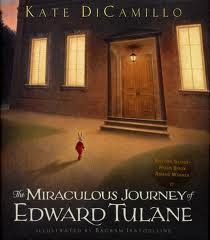
"Do you have a book about a rabbit named Edward Tulane?" a student of mine asked me about a week ago?  I checked the computer catalogue.  Nope.  I went to the Internet and found it online.  The Miraculous Journey of Edward Tulane by Kate KiCamillo.  Hmmm.  $4?  I think we can manage that.  (By the way, I am going to promote Abe Books ad nauseam.  I find amazing deals here weekly and help make both kids and myself happy really inexpensivelyy.) 

"We don't have it, but I could get it.  Would you like me to?"  I asked.  "Yes, please."  (Oh, how I especially love the ones with manners.)  "Ok.  It'll take at least a week, but I'll let you know when it comes in and I have it ready for you,"  I told her. 


The book arrived last weekend and I was drawn to the cover art.  Kate DiCamillo, the author, had written The Tale of Despereaux,  the heart-wrenching mouse and princess story which my son and I had listened to on audio just last summer.  The story had been emotional and magical.  (No, I haven't seen the movie and can't compare it.  Maybe later . . .)  I thought I might just peek inside this book and see just what was so special that a student would remember it and ask for it. 

Edward is a custom-made china doll that had been commissioned by a woman for her granddaughter.  He had hinged arms and legs and sported real rabbit fur, although "whom the whiskers had belonged to initially-what unsavory animal-was a question that Edward could not bear to consider for too long."  Edward has a wardrobe of fine clothing and his little mistress, Abilene, dotes on him.  He sits at the table while the family has their meals, much to the amusement of Abilene's parents.  The grandmother, Pellegrina, on the other hand, seems to know that Edward is more than just a doll, and she is disappointed in his snotty attitude.

I was hooked by page 16, when the neighboring Boxer comes into the house "uninvited and unannounced" and commences to urinate on the white tablecloth and shake Edward back and forth "vigorously, growling and drooling." 

We have a boxer and I could just see ours pulling the same stunts.  I decided to keep the book just a little longer, just to see where the story might go.  Well, tonight I put off the dishes and sat for about 30 minutes, reading this book up like a bowl of gravy with rice.  Edward starts off as a vain, contemptuous, bored rabbit; ignoring the babbling of his adoring charge.  He is taken on a cruise with the family and is accidentally flung into the ocean by some teasing boys.  All the stricken Abilene is left with is his fine pocket watch.

Spoiler alert:  I will just quote the Coda, which summarizes the rest of the story, which had me weeping into a towel. 

Once, there was a China Rabbit who was loved by a little girl.  the rabbit went on an ocean journey and fell overboard and was rescued by a fisherman.  He was buried under garbage and unburied by a dog.  He traveled for a long time with the hobos and worked for a short time as a scarecrow.
Once, there was a rabbit who loved a little girl and watched her die.
The rabbit danced on the streets of Memphis.  His head was broken open in a diner and was put together again by a doll mender.
And the rabbit swore that he would not make the mistake of loving again.
Once there was a rabbit who danced in a garden in springtime with the daughter of the woman who had loved him at the beginning of his journey.  The girl swung the rabbit as she danced in circles.  Sometimes, they went so fast, the two of them, that it seemed as if they were flying.  Sometimes, it seemed as if they both had wings.
Once, oh marvelous once, there was a rabbit who found his way home.

I loved the message that DiCamillo expressed on page 189.  Edward is sitting on a shelf in the doll mender's shop, feeling empty and like nothing is worth anything.  A 100-year-old doll is placed next to him on the shelf.  She has been on a long journey and wonders who will come for her next. 

"I don't care if anyone comes for me," said Edward.
"But that's dreadful," said the old doll.  "There's no point in going on if you feel that way.  No point at all.  You must be filled with expectancy.  You must be awash in hope.  you must wonder who will love you, whom you will love next. "
"I am done with being loved," Edward told her.  "I'm done with loving.  It's too painful."
"Pish," said the old doll.  "Where is your courage?"
"Somewhere else, I guess," said Edward.
"You disappoint me," she said.  "You disappoint me greatly.  If you have no intention of loving or being loved, then the whole journey is pointless.  You might as well leap from this shelf right now and let yourself shatter into a million pieces.  Get it over with.  Get it all over with now."
"I would leap if I was able," said Edward.
"Shall I push you?" said the old doll.
"No, thank you," Edward said to her. "Not that you could," he muttered to himself. 
I found the book lovely.  Special.  One of the good ones.  Tomorrow I'll take it to school, stick on a barcode and a date due paper, cover it in plastic and let the sweet girl know her book is ready.  When she brings it back, I will place it on my "Mrs. E's Pick Favorite's" shelf.                               Thanks for listening.

Saturday, November 6, 2010

When Food is Love

Geneen Roth is an author who explores the intimate relationship between eating and feeling good, feeling loved, feeling stable.  She has written quite a few books, such as The Craggy Hole in My Heart and the Cat Who Fixed ItWhen You Eat at the Refrigerator, Pull Up a Chair  and Women, Food and God.  For those of you with no patience for people who believe in exploring childhood experiences and how they affect our adult lives, go ahead and stop reading now.

For the rest of us who are interested in linking our behaviors and thought patterns with the past, Roth does an amazing job.  She is nakedly honest in her books and touches many nerves in my psyche as I read about her struggles. 

Here are some of my own food patterns:  I like to eat alone, with a book or the tv on.  I like my food in a bowl to be eaten with a spoon.  I like my food to touch, in fact, I create crazy mixes of flavors that make my husband and son shudder.  (My favorite way to eat spaghetti is with my dressed salad mixed in.  I learned this trick as a child.  I was not allowed to leave my Grandmother's table unless all my food was gone.  Over time I came up with a lot of devious ways to escape from the "yucky" parts of the meal like hiding the food in my underwear and flushing it down the toilet, learning to use my tongue to close off my sense of taste while chewing the food with a mouthful of milk and swallowing it down, and by camouflaging flavors by putting something I liked with something I didn't.  Thus my love for pasta sauce on salad was born.  Don't worry, I like salad now.)  I don't like to be interrupted when I eat.  I hate when the phone rings and I most likely will not answer it, or will be grouchy and short-lipped with the caller if I feel I must speak at that time.  I like my food to be piping hot, but can also handle the leftovers straight from the fridge.  My mom sometimes gave me leftover dinner for lunch.  My schoolmates sometimes raised an eyebrow at my tacos or meatloaf sandwiches, but now I can eat leftover dinner for breakfast anytime.  Prefer it to eggs, actually!

I gained quite a bit of weight last summer.  I had quit some habits that weren't healthy for me and as soon as I heard the term "cross-addiction" I knew food would be my next "feel good" retreat.  I eat when I'm happy, sad, mad, bored, wanting comfort, wanting sleep, or just because it's there.  Learning to eat when only hungry is quite a challenge.  Learning to eat smaller portions of protein and starch (especially rice, which I LOVE) and more veggies is a mind-game for me.  I make my plate (or bowl), heaped with veggies, but in the back of my mind I am contemplating the protein I will have for seconds. 

I didn't finish When Food is Love, but it is overdue at the library and I am going to return it today.  Here is what I gleaned so far: 

"Diets don't work because food and weight are the symptoms, not the problems.  The focus on weight provides a convenient and culturally reinforced distraction from the reasons why so many people use food when they are not hungry.  These reasons are more complex than-and will never be solved with--will-power, counting calories, and exercise.  They have to do with neglect, lack of trust, lack of love, sexual abuse, physical abuse, unexpressed rage, grief, being the object of discrimination, protection from getting hurt again.  People abuse themselves with food because they don't know they deserve better.  People abuse themselves because they've been abused.  They become self-loathing, unhappy adults not because they've experienced trauma but because they've repressed it."  (p. 4)

I feel I need to post a disclaimer here.  My childhood was, for the most part, very safe and loving.  Like pretty much everyone else I know, however, there are things I need to acknowledge, accept, forgive and let go.  When my "buttons are pushed" and I overreact unreasonably to not getting my own way or feeling abandoned or ignored, these are signs that stuff from the past is still shaping who I am and how I see the world.  Back to the book.

"When Food is Love speaks to the heart of why people turn to food.  It explores the messages we received as children, how we translate them into messages of self-hate, and how we pass this pain on to other people, including our children.  And it explores the importance of taking responsibility for change in the present rather than feeling victimized by the pain of the past.  Because our patterns of eating were formed by early patterns of loving, it is necessary to understand and work with both food and love to feel satisfied with our relationship to either." (p. 4)

My favorite line in the last paragraph is "the importance of taking responsibility for change in the present rather than feeling victimized by the pain of the past".  This is easier said than done, however, especially when I am in the throes of passionate emotion.  My ego rides that roller coaster and all sorts of voices speak in my head, promoting "unfairness" and "you don't really know me" and "you're gonna f*** it up anyway, so who are you kidding?"  Phew.  It makes me amped just to think about it.  How does one reprogram one's brain to stop reacting in such an emotional manner to people and situations in our lives that we can't control anyway???

"Compulsion is despair on the emotional level.  The substances, people, or activities that we become compulsive about are those that we believe are capable of taking our despair away.   . . .  Someone once came to a workshop after she had lost seventy-five pounds on a diet.  She stood up in front of 150 people and, with her voice shaking, said, "I feel like I've been robbed.  My best dream has been taken away.  I really thought that losing weight was going to change my life.  But it only changed the outside of me.  The inside is still the same.  My mother is still dead and my father still beat me when I was growing up.  I'm still angry and lonely and now I don't have getting thin to look forward to."     (p. 15)
"Compulsion is the feeling that there is no one home.  We become compulsive to put someone home.  All we ever wanted was love.  We didn't want to become compulsive about anything.  We did it to survive.  We did it to keep from going crazy.  Good for us.  Food was our love; eating was our way of being loved.  Food was available when our parents weren't.  Food didn't get up and walk away when our fathers did.  Food didn't hurt us.  Food didn't say no.  Food didn't hit.  Food didn't get drunk.  Food was always there.  Food tasted good.  Food was warm when we were cold and cold when we were hot.  Food became the closest thing we knew of love.  But it is only a substitute for love.  Food is not, nor was it ever, love." 
"Many of us have been using food to replace love for so many years that we no longer know the difference between turning to food for love and turning to love for food.  We wouldn't recognize love if it knocked us over.  Not because we are ignorant but because if we've never been loved well, we don't know what love feels like, what love is like.  And it follows that if we have not been loved well, we cannot love ourselves well.  Compulsive behavior, at its most fundamental, is a lack of self-love; it is an expression of a belief that we are not good enough." (pps. 18-19)

I could go on and on, quoting this amazing book that I have not even finished yet, but my belly is grumbling (ha!) and my coffee is cold and this book needs to get back to the library pronto.  Someone else has put it on hold and I got an embarrassing letter in the mail yesterday from the library.  Let me just parrot a few more tidbits and then I'll let you go:

"Love and compassion cannot coexist.  Love is the willingness and ability to be affected by another human being and to allow that effect to make a difference in what you do, say, become.  Compulsion is the act of wrapping ourselves around an activity, a substance, or a person to survive, to tolerate and numb our experience of the moment.  Love is a state of connectedness, one that includes vulnerability, surrender, self-valuing, steadiness, and a willingness to face, rather than run from, the worst of ourselves.  Compulsion is a state of isolation, one that includes self-absorption, invulnerability, low self-esteem, unpredictability, and fear that if we faced our pain, it would destroy us.  Love expands, compulsion diminishes.  Compulsion leaves no room for love-which is, in fact, why many people started eating: because when there was room for love, the people around us were not loving.  The very purpose of compulsion is to protect ourselves from the pain associated with love."
"It is my belief that we become compulsive because of wounds from our past and the decisions we made at that time about our self-worth--decisions about our capacity to love and whether, in fact, we deserve to be loved.  Our mother goes away and we decide that we are unlovable.  Our father is emotionally distant and we decide that we need too much.  Someone we are close to dies and we decide that there is no reason to love anyone because it hurts too much at the end.  We made decisions based on how we made sense of the wounds and what we did to protect ourselves from being more wounded in that environment.  At the age of six or eleven or fifteen, we decide that loves hurts and that we are unworthy or unlovable or too demanding, and we live the rest of our lives protecting ourselves from being hurt again.  And there is no better protection than wrapping ourselves around a compulsion."  (pps. 23-24)

I myself am compulsive about a few things.  Just a few come to mind immediately, but perhaps there are more lurking beneath the surface.  I compulsively shop.  I compulsively create projects for myself.  I compulsively speak without thinking.  There are more, but I don't feel like baring any more of my tender neurosis to the public.  Let's just say that I'm gonna work on this self-esteem thing some more.  How about you?

Want to read more?  Check out Geneen's blog at:  http://blog.geneenroth.com/notes_from_geneen/.  You can order her books through her site.  You can also find some at a more discounted price (used and new versions are available) at http://www.abebooks.com/servlet/SearchResults?an=geneen+roth&sts=t&x=0&y=0.  I know I promote Abe Books enough to be an official spokesperson, but hey, when you can get a book for less than 4 bucks, including s/h, how can you lose?

Thanks for listening.  Take care of yourself.  Today I will notice my triggers and get a little more introspective about them.  Thanks for listening.